Loading…
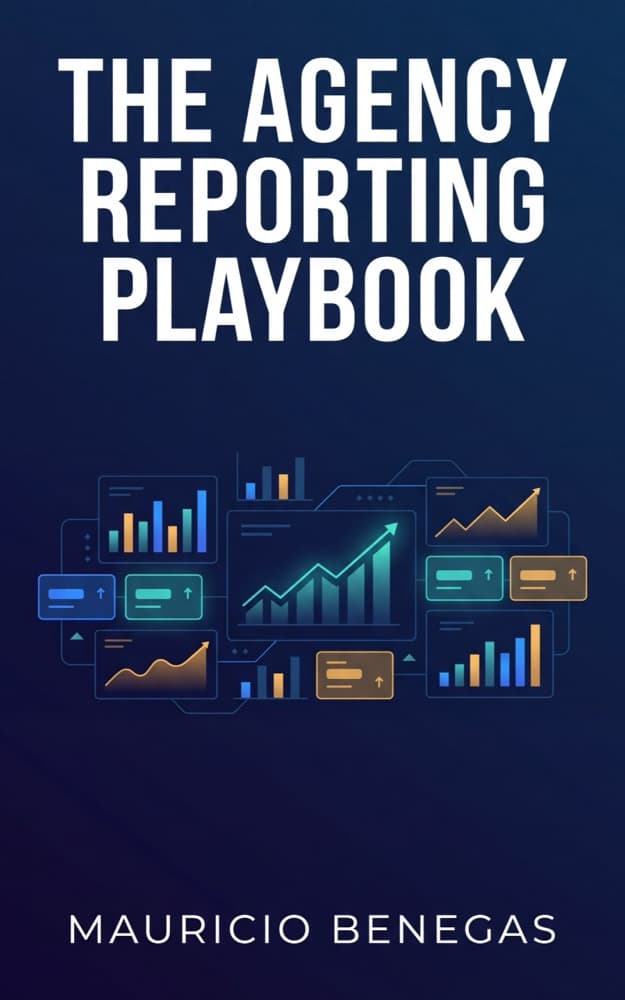
The book
The Agency Reporting Playbook
Build a reporting workflow your agency can run without rebuilding it every month. Start with clear KPI definitions, connect the data, check the numbers, and add AI-assisted commentary only where it helps. Includes worked SQL, four KPI dictionaries, and a practical install kit.
Reader resources (worldwide, free, no signup) →
Written for founders and operators of marketing agencies with 3-30 clients. Available to read with a Kindle Unlimited subscription. Check Amazon for current terms.
The framework the book is built on
Every agency reporting setup sits at one of four stages. The book shows how to diagnose yours and what specifically moves you to the next one.
01
Manual
Every report rebuilt from scratch; one person holds it together.
02
Fragile
Templates exist but break under pressure; numbers disagree.
03
Scalable
Standardized dashboards and a SOP your whole team follows.
04
AI-ready
Structured, clean data flows source-to-insight; AI tools read it without cleanup.
Selected topics from the book
Fourteen chapters plus the Install Kit. These are some of the decisions and worked examples you will find inside the Kindle edition.
01
The real cost of manual reporting
What "report week" actually costs in margin, trust, and the clients you never onboarded.
02
The four stages of reporting maturity
Manual, Fragile, Scalable, AI-ready - and how to diagnose yours honestly.
03
Stuck at Manual
The three habits that keep reporting hand-made, and what to fix before automating anything.
04
The Fragile trap
The limits of connecting dashboards straight to ad platforms, and the four-question test.
05
The Scalable architecture
Warehouse-first reporting: extraction, storage, modeling, presentation - and what it costs.
06
The KPI dictionary
The one-page document that makes your numbers credible and your automation possible.
09
Reports clients actually read
The 90-second rule, the commentary skeleton, and a weekly pulse that surfaces issues sooner.
10
AI-ready - what stage 4 looks like
Anomaly alerts, drafted commentary, plain-language questions - and the prerequisite nobody markets.
13
The 30-day install
Week by week: decide, plumb, model, present - plus the two failure modes.
14
Build it or buy it
An honest framework for deciding who does the work, from the people who do it for a living.
The implementation material is already in the book.
Part V includes four complete KPI dictionaries, a worked SQL modeling project, data-quality tests, a dashboard specification, client-facing documents, and operating checklists. Use them with the chapters, then adapt them to your own systems and definitions.
The free reader resources need no signup. The separate Standard and Pro template products are optional purchases, not a requirement for using the book.
View the Kindle editionThe book is chapter one of a larger system.
Everything the book teaches connects to a concrete next step - most of it free. Go as far as your situation actually calls for.
Want help applying this to your reporting workflow?
Start with one reporting process. We map the current work, agree on a baseline, and scope the smallest useful implementation on your existing stack. The ownership, testing, and handoff standards in chapter 14 still apply. Scope and timing are agreed before a build begins.